Minister Foley and Minister Higgins publish World Health Organization report on Ireland’s provision of Assistive Technology

Minister for Children, Disability and Equality, Norma Foley and Minister of State with responsibility for Disability, Emer Higgins have today launched the Assistive Technology Capacity Assessment Report for Ireland.

Assistive technology encompasses a wide range of products to support people in their daily activities and participation in society. It includes glasses, hearing aids, subtitles, communications boards, screen readers, wheelchairs, shower chairs, hoists, and pill organisers.

The Assistive Technology Capacity Assessment Report for Ireland is the most comprehensive review to date of Ireland’s assistive technology provision. It was conducted by the World Health Organization Regional Office for Europe between 2024 and 2025.

The report found that Ireland is strongly committed to funding Assistive Technology through a variety of schemes and innovative pilot programmes.

The report underscores the very positive progress Ireland has made in recent years in expanding access to Assistive Technology and identifies ways in which this access could be strengthened.

Launching the report, Minister Foley said:

“This WHO report shows how assistive technology can provide “life changing” experiences for people of all ages and abilities. A student with dyslexia can use text-to-speech software to aid their learning. An older adult might rely on a walking aid to maintain independence. Assistive technology allows people to express themselves, to participate in education and employment, and to live more independent and fulfilled lives.

This report recognises the investment Government has made to introduce or expand assistive technology schemes. It also demonstrates where gaps in provision remain, such as the lack of data on the need for assistive technology in this country. The new National Disability Survey, which will be carried out by the Central Statistics Office next year, offers an opportunity to address this.”

Also speaking at the launch, Minister of State Higgins said:

“For people with disabilities, assistive technology can be the key enabler which allows them to realise their rights across a broad range of sectors. For example, having access to screen readers can support a person to engage in work or education. Hearing aids and communication devices can support language development and participation in communities. And appropriate mobility aids can reduce isolation and contribute to overall wellbeing.

The report we are publishing today is a significant milestone in Ireland’s continued efforts to develop an assistive technology ecosystem which is centred around the needs of users of assistive technology and their lived experience”.

Assistive technology can prevent further health complications, reduce healthcare costs, and support people being able to live at home into their old age.

The current government schemes to support Assistive Technology include the following:

  • the Department of Children, Disability and Equality’s Access and Inclusion Model for children with disabilities in early years education
  • the HSE’s Aids and Appliances scheme
  • the Department of Housing’s Housing Adaption Grants
  • the Department of Social Protection’s Work and Access scheme
  • the Department of Education’s Assistive Technology Grant
  • the Department of Further and Higher Education’s Fund for Students with Disabilities
  • the HSE’s Cooperative Real Engagement for Assistive Technology Enhancement (CREATE) fund
  • the Disabled Drivers and Disabled Passengers Scheme provides tax relief for purchase of vehicles
  • VAT refunds on eligible assistive products, such as hoists, communication devices, and mobility aids.
  • Zero VAT on wheelchairs, hearing aids, prosthetics etc

The WHO report is available to read here.

Notes to Editors

Assistive technology is an umbrella term for assistive products and their related systems and services. Assistive products help maintain or improve an individual’s functioning related to cognition, communication, hearing, mobility, self-care and vision, thus enabling their health, well-being, inclusion and participation.

Globally, more than 2.5 billion people need one or more assistive products, relying on them to live independently, stay connected, and participate fully in daily life. The WHO and UNICEF Global Report on Assistive Technology (GReAT), launched in 2022, highlights that this number is expected to grow to 3.5 billion by 2050. This rise reflects longer lives and increasing rates of noncommunicable diseases.

In March 2024, the Irish Government entered into a €12.524m donor agreement (split evenly over a period of five years) with the WHO to strengthen equitable access to assistive technology globally, with a focus on innovation in people-centred, rights-based service delivery models and harnessing the potential of digital assistive technology (DAT).

In addition, the Department of Children, Disability and Equality is progressing a Project Collaboration Agreement with the WHO which is focused on domestic objectives. The independent Assistive Technology Capacity Review being published today is a key deliverable of this agreement.
Minister Foley announces intention to include first cousins in an Identification Programme under the Institutional Burials Act 2022

Minister for Children, Disability and Equality, Norma Foley, has today announced her intention to include first cousins as eligible family members who can participate in an Identification Programme under the Institutional Burials Act 2022.

She made the announcement following the Cabinet meeting this morning where she received Government approval to draft the necessary amendments to the 2022 Act.

The Minister brought the proposals to Government on foot of updated scientific advice from Forensic Science Ireland that supports the inclusion of first cousins in an Identification Programme under the Act.

If the necessary legislation is passed by the Houses of the Oireachtas, first cousins of children believed to be buried at the site of the former Mother and Baby institution in Tuam will be able to participate in the Identification Programme that is currently underway in relation to the site.

Speaking today Minister Foley said:

“I know that the Identification Programme is very important for people who believe they have family members buried at the site of the former Mother and Baby institution in Tuam.

Forensic Science Ireland recently informed me of new scientific developments since the enactment of the legislation that allow for DNA matching of sufficient quality to support the inclusion of first cousins in an Identification Programme.

I understand that there are first cousins who are interested in participating in the Tuam Identification Programme so I, and the Government, were keen to move quickly on this when the scientific advice was updated.

The Government has now approved my proposal to amend the Institutional Burials Act 2022 to include first cousins in an Identification Programme.”

Officials in the Department of Children, Disability and Equality will now work with the Office of the Attorney General to draft amendments with a view to introducing them in the Houses of Oireachtas as soon as possible.

ENDS

Notes to Editor:

The Institutional Burials Act 2022 provides a legislative basis for the excavation, recovery, analysis, identification (if possible) and reburial of remains that have been buried in a “manifestly inappropriate” manner on land associated with a former residential institution in which a public body had, or has, a relevant role.

Part 4 of the Act provides for an Identification Programme. The purpose of an Identification Programme is to establish whether there is a familial link between people who believe they have a family member buried at an intervention site and the human remains that are recovered from the site, and, where a familial link is established, to identify the recovered remains.

The 2022 Act defines an “eligible family member” as a person who has reasonable grounds to believe that he/she is a child, parent, sibling, half-sibling, grandparent, grandchild, aunt, uncle, niece, nephew, half-niece, half-nephew, grandniece or grandnephew of the person who is believed to be buried at an intervention site.

The list of eligible family members set out in the Act reflects the scientific advice provided at the time by Forensic Science Ireland (FSI).

In March 2026 the Director General of Forensic Science Ireland wrote to the Department recommending that the list of eligible family members be broadened to include first cousins. The scientific basis for the inclusion of first cousins, which was outlined by the Director, includes the recent availability of published data on the performance of new technology being used by FSI and subsequent FSI validation testing.

The Director’s letter is supported by a letter from the Government’s Science Advisor.

Minister Foley announces €600,000 in funding for the development and refurbishment of playgrounds and play areas nationwide

Minister for Children, Disability and Equality, Norma Foley, has today announced the recipients of this year’s Capital Grant Scheme for Play and Recreation, with a total of €600,000 awarded to 30 Local Authorities across the country.

The Capital Grant Scheme for Play and Recreation supports the work of Local Authorities in improving access to quality play and recreation facilities within their communities. This can be through the refurbishment and upgrade of existing facilities or through the development of new ones. The scheme offers funding of up to €22,000 per project, an investment that will see positive impacts delivered to children and families across the country.

Many of the projects funded under this year’s scheme give particular focus to inclusion and access and will help children with a diverse range of needs to avail of the benefits of high-quality play facilities alongside their peers. Some of these funded projects include the installation of:

  • Wheelchair-accessible seesaws
  • Inclusive sensory playground equipment and inclusive play space
  • Upgraded accessibility features and biodiversity planting
  • Level Access Play Equipment
  • Teen Spaces

Announcing the award of funding, Minister Foley said:

“I am delighted to announce this year’s Capital Grants for Play and Recreation, which will provide vital support for communities in developing vibrant, inclusive, and accessible spaces for children and young people. These investments reflect our strong commitment to ensuring that every child has the opportunity to play, explore, and thrive in safe and inspiring environments.

We look forward to working closely with each local authority to deliver these projects that will enhance wellbeing, promote active lifestyles, and strengthen community connections across the country.”

Note for Editors:

The Play and Recreation Capital Funding Scheme was introduced in 2013 to support new and existing play and recreation facilities for children and young people.

The 2026 scheme aims to support:

  • The refurbishment of existing play and recreation facilities
  • The incorporation of natural play elements
  • The development of new play and recreation facilities.

The application process was open to all Local Authorities, who could each nominate one project for funding. Funding was capped at €22,000 per project. The awarding of this funding is contingent on the Local Authority matched funding of at least 25% of the amount provided by the Department of Children, Disability and Equality towards the project.

Eligible applications were evaluated by the Department and via a weighted scoring system; each of the 5 qualifying criteria was assessed and scored individually and the total project score was an aggregate of the criteria scores.

These criteria included the project’s added value to young people, its accessibility and inclusivity, the nature of consultation with local children and young people, the evidence provided of the ability to complete the project, and the corroboration of need provided in support of the application.

A list of the successful projects, and the funding awarded is as follows:

Local Authority Project:
Title/Description
Funding
Amount
Carlow Installation of multi-use games area (MUGA) in
Tullow Town Park
(1 Mill St, Templeowen, Tullow, Co. Carlow)
€20,516
Cavan Upgrade of Arva Playground
(Gartylough, Arva, Co.Cavan)
€18,970
Clare Refurbishment of Tim Smyth Park Playground, Ennis

(Lifford Rd, Ennis, Co. Clare)

€18,685
Cork City Playground Upgrade – Pophams Park
(3 Fairfield Green, Farranree, Cork)
€18,578
Cork County Refurbishment of Carrigtwohill Playground
(50 Main St, Carrigtohill, Co. Cork)
€20,516
Donegal Refurbishment of Convoy Playground
(18 Ard Mhuileann, Milltown, Convoy, Co. Donegal)
€21,470
Dublin City Albert College Park Playground Upgrade, Glasnevin
(Ballymun Road, Glasnevin, Dublin 11)
€20,000
Fingal Purchase and installation of an inclusive
carousel and play panels for Ongar Park Playground
(Ongar, Dublin 15)
€20,755
Galway City Council Sliding Rock Playground Enhancement – Shantalla
(McDara Road, Shantalla, Galway City)
€19,800
Galway County Council New Play and Recreation Facilities Project 2026 –
Renville Playground
(Rinville West, Oranmore, Co. Galway)
€21,709
Kerry Inclusive upgrade to Castleisland Playground,
with the installation of level access play equipment.
(Castleview, Tonbwee, Castleisland, Co. Kerry)
€21,470
Kildare Moorefield Park Playground, Newbridge
(Moorfield, Newbridge, Co. Kildare)
€22,000
Kilkenny Graiguenamanagh Playground Improvements
(Fairview, Graiguenamanagh,Co. Kilkenny)
€17,415
Laois Accessibility, biodiversity and natural play
enhancement of Páirc an Phobail Playground, Portlaoise
(Timahoe Road, Portlaoise, Co. Laois)
€21,470
Leitrim Inclusive and accessible upgrade for Dristernan
Playground, Drumshanbo
(Dristernan, Drumshanbo, Co.Leitrim)
€22,000
Limerick Canon Breen Park, Thomondgate Play Space
(Canon Breen Park, Limerick City)
€20,755
Longford The Green – Edgeworthstown Playground
(Tinnynarr, Edgeworthstown, Co. Longford)
€21,470
Louth Tinure Playground refurbishment
(Tinure, Co.Louth)
€15,955
Mayo Playground Refurbishment at Murrisk
(Murrisk Demesne, Co. Mayo)
€17,892
Meath Installation of new play equipment at Blackwater
Park Playground, Navan
(Ratholdren Rd, Abbeyland, Navan, Co. Meath)
€20,278
Monaghan Teen Hangout Amenity in Emyvale
(Emyvale Co.Monaghan)
€22,000
Offaly Extension and refurbishment of children’s
playground at Grove Street, Crinkill
(Crinkill, Birr Co.Offaly)
€19,562
Roscommon Upgrade works, Portunny Playground, Knockroghery
(Portrunny Co.Roscommon)
€19,562
Sligo Mitchell Curley Park Playground – inclusive
sensory playground equipment, Sligo Town
(Ballydoogan, Sligo Co.Sligo)
€20,993
South Dublin Refurbishment and expansion of Waterstown Park
Play Space, Palmerstown
(Waterstown Ave, Palmerston Lower, Dublin 20)
€20,278
Tipperary Dromineer Playground – Improvement Works
(Dromineer, Co. Tipperary)
€19,562
Waterford Replacements for multi-play units – Walton Park
Playground, Dungarvan
(Walton Park, Dungarvan, Co.Waterford)
€19,562
Westmeath Upgrade works to the Rotary Playground –
Mullingar Town Park
(Pearse St, Mullingar, Co. Westmeath)
€20,516
Wexford Enhancement of Fethard on Sea Playground
(Fethard, Co. Wexford)
€18,369
Wicklow The Murrough natural play & calisthenics
space for kids and teens, Wicklow Town
(The Murrough, Wicklow, Co.Wicklow)
€17,892
Total €600,000

Minister Foley announces new €10 million capital scheme for early learning and childcare services

Minister for Children, Disability and Equality Norma Foley has announced the opening of a €10 million capital funding scheme to deliver a significant number of additional early learning and childcare places.

The Building Blocks Extension Scheme Phase 2 will provide grants for community and private early learning and childcare services who are Core Funding partner services to increase their capacity by means of extensions to their existing premises.

Community providers can apply for a capital grant of between €100,000 and €530,000 to extend their existing premises. Private providers can apply for a capital grant of between €50,000 and €265,000 to extend their existing premises.

All projects will be required to deliver net increases in full-time places for one to three-year-olds. Projects will also be required to incorporate Universal Design Guidelines.

Announcing the opening of the scheme, Minister Foley said:

“I am very pleased to formally launch this scheme which will deliver a welcome increase in high quality, affordable places, particularly for younger children. The scheme builds on the success of Phase 1 of the Building Blocks Extension Scheme, which is currently operating, and which will deliver up to 1,500 additional places.”

The Building Blocks Extension Scheme is part of the wider Building Blocks Capital Programme for Early Learning and Childcare under the revised National Development Plan 2021-2030 (NDP).

The scheme will run in tandem with and will complement the State-led Early Learning and Childcare Capital Programme, for which €135 million will be made available over the next five years.

The Department of Children, Disability and Equality continues to progress a range of other actions to increase the supply of quality and affordable early learning and childcare including significantly increased investment in the Core Funding scheme and the National Childcare Scheme over the past two years.

Note for Editors:

Building Blocks Extension Grant Scheme

The scheme is open to Core Funding Partner Services that:

  • will offer additional full-time places for the 1–3-year-old (pre-ECCE) age-cohort;
  • part-time services, sessional services and school age childcare services that are willing to extend their operations to provide full time places for the 1-3-year-old (pre-ECCE) age-cohort;
  • will commit to opening for a minimum of 46 weeks per year, five days per week and 8 hours per day.

There are two strands to the Scheme, as follows:

Community strand:

  • Community providers can apply for a capital grant of between €100,000 (minimum) and €530,000 (maximum) to extend their existing premises.
  • Match funding is not a requirement.
  • Project values between €100,000 and €680,000 will be eligible.
  • Any additional project costs between €530,000 and €680,000 must be funded by the provider.

Private strand:

  • Private providers can apply for a capital grant of between €50,000 (minimum) and €265,000 (maximum) to extend their existing premises.
  • Match funding will be required.
  • Project values between €100,000 and €680,000 will be eligible.
  • Any additional project costs between €530,000 and €680,000 must be funded by the provider.

Eligible projects are limited to physical extensions to existing premises. This may include the physical extension of an existing premises or the installation of a modular building.

All proposed projects must adhere to the Early Years Services Regulations 2016 and must incorporate Universal Design Guidelines for Early Learning and Care Settings (UDG).

The closing date for applications is 31 July 2026. This will ensure that all applicants have sufficient time to engage with their design teams and their solicitors prior to the closing date. The outcome of the appraisal process will be communicated to services in September 2026.

Successful applicants can commence their projects after 1 January 2027 and all projects must be completed by 31 December 2027.

Invitation to Nurturing Skills Midpoint Review Workforce Focus Group

Educators/Practitioners Wanted – Nurturing Skills: The Workforce Plan for Early Learning and Care and School-Age Childcare 2022-2028 Focus Group


Share your professional experience and help inform priorities, we’d love to hear from you.

The Department of Children, Disability and Equality are seeking Educators/practitioners to contribute to a focus group for the Mid‑Term Review of the Nurturing Skills: The Workforce Plan for Early Learning and Care and School-Age Childcare 2022-2028.

The Nurturing Skills Workforce Plan is a national plan for Early Learning and Care (ELC) and School‑Age Childcare (SAC) staff in Ireland. It runs from 2022–2028 and explains how the Government will support, develop, and professionalise the workforce.

In simple terms, it is a roadmap for making sure Early Years Educators, School‑Age Childcare practitioners, and childminders are:

  • well‑qualified
  • well‑supported
  • valued as professionals
  • able to access clear career pathways

The plan aims to strengthen the workforce through five pillars:

  1. Establishing a career framework
  2. Raising qualification levels
  3. Developing a national Continuing Professional Development (CPD) system
  4. Supporting recruitment, retention and diversity
  5. Moving towards regulation of the profession

DCDE are currently conducting a midpoint review of Nurturing Skills to examine progress to dates and develop a new implementation plan which will set out the actions needed to reach the objectives of the plan from 2026-2028.

As part of the Mid-Term Review of Nurturing Skills: The Workforce Plan for Early Learning and Care and School-Age Childcare 2022–2028, the Department is seeking to engage directly with the workforce through an online focus group.

  • Date: Tuesday, 28 April
  • Time: 7.00pm – 8.30pm
  • Format: Online (Microsoft Teams)

The focus group provides an important opportunity for those working in the sector to:

  • Share their professional experiences
  • Reflect on progress to date
  • Help inform priorities and actions for the next phase of the plan (2026–2028)

Participation is open to a wide mix of roles and backgrounds, and the session will take place online to support accessibility.

If you would like to apply to participate in the focus group please complete the survey at the link below.

Click here

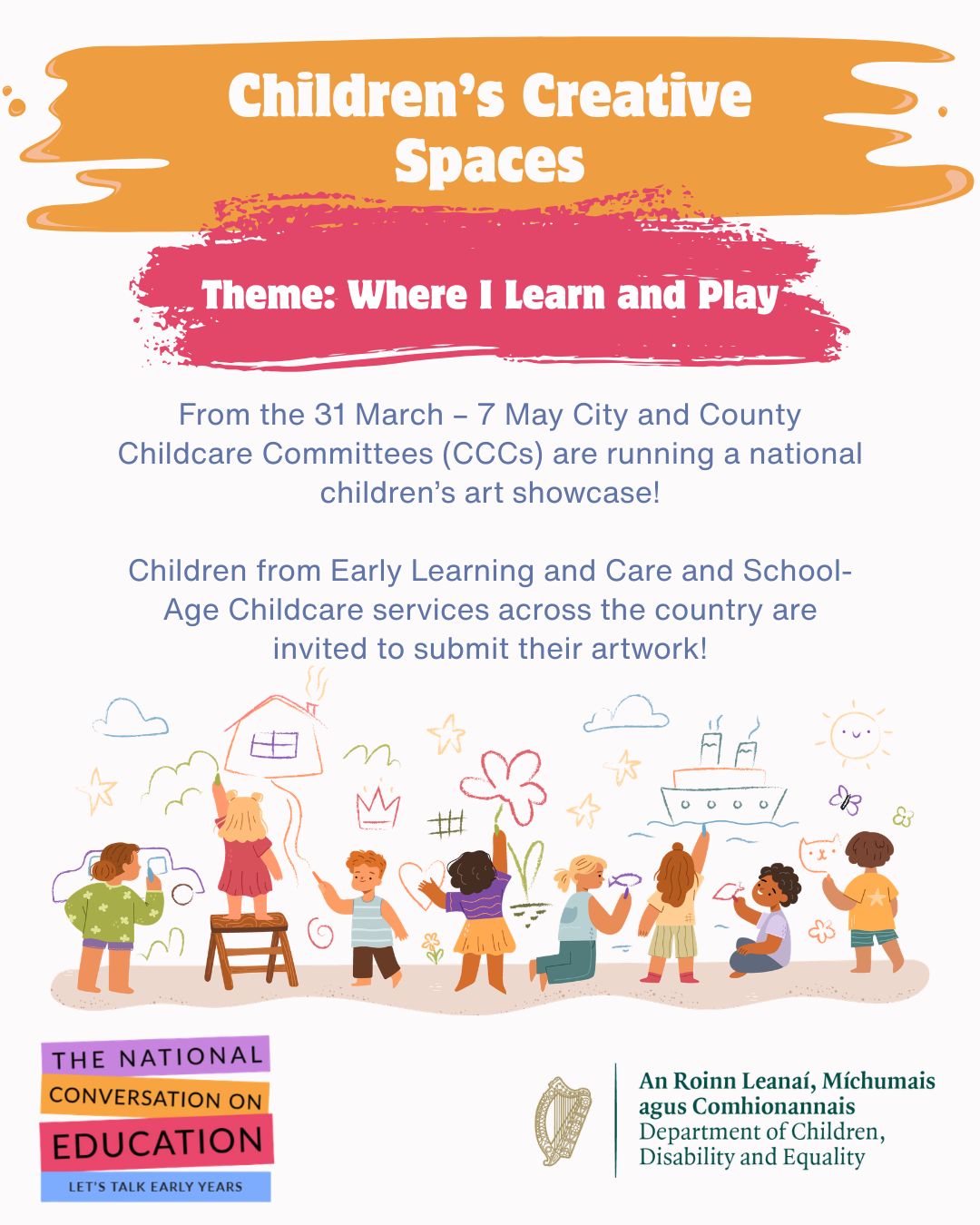
National Conversation on Education – Children’s Creative Spaces

National Conversation on Education – Children’s Creative Spaces

Minister for Children, Disability and Equality Norma Foley is inviting children from Early Learning and Care and School-Age Childcare services across the country to take part in Children’s Creative Spaces celebrating the theme “Where I learn and play” The aim is to give children the opportunity to express creativity, belonging, and their own experiences of their setting (Early Years or School‑Age Childcare/After‑School) adding their voice as part of the National Conversation on Education: the First Five Years and School-Age Childcare.

We have circulated an email with guidance information to you this week.

Timeline

31 March – 30 April:

Educators/settings engage in art activities with the children in their service using guidance provided by DCDE.

7 May:

Submit digital version of artwork to Carlow CCC: info@carlowccc.ie

15 May – 31 May:

Keep an eye out for local galleries on your CCC website and social media accounts.


Please note artwork submitted to the Children’s Creative Spaces may be published on gov.ie, on CCC websites, in future government documents, in follow-up reports, and on social media accounts. By submitting artwork, it will be taken that consent has been obtained by services from children and parents for the Department of Children, Disability and Equality and the City and County Childcare Committees.

If you want further info please contact us : info@carlowccc.ie


Minister Foley encourages people to attend Consultations on Early Learning and Care and School Age Childcare around the countr

Minister for Children, Disability and Equality Norma Foley is encouraging people to attend the local Consultation on Early Learning and Care and School‑Age Childcare in their area as part of the National Conversation on Education.

The Department of Children, Disability and Equality (DCDE), in partnership with County Childcare Committees, today announced details of the upcoming local consultation events.

Places are limited. Those interested in taking part can book a place online at gov.ie/LetsTalkEarlyYears.

The consultation process seeks views from parents, early years educators, school‑age childcare practitioners, childminders, providers and anyone interested in the issues.

It is the latest step in the National Conversation on Early Years which is already generating significant debate. New figures show that almost 12,000 responses were received during a national online survey on Early Years, which closed on 12 March.

In total, 51 local consultation events are being held across Ireland between 20–30 April 2026. Each local consultation event will run for approximately 1.5–2 hours. Participants will join small table groups focusing on three core themes (Accessibility, Affordability, Quality).

These local consultations offer the public an opportunity to:

  • Share what is working well and what needs to change.
  • Identify priorities for future investment and improvement.
  • Ensure the voices of parents, early years educators, school-age childcare practitioners, childminders, providers and communities shape national policy.
  • Contribute to an affordable, accessible, high‑quality early learning and care and school-age childcare system.

The consultation events will be delivered in collaboration with the 30 local City and County Childcare Committees (CCCs). Input gathered at local level will inform both Phase 2 of Shaping the Future—the Government’s Early Years Action Plan—and the successor to First 5, Ireland’s Whole‑of‑Government Strategy for Babies, Young Children and their Families.

Minister for Children, Disability and Equality, Norma Foley said:

“More than 11,000 people have had their say online about the future of early years education. That is really impressive and now is the time for the local consultation stage of the Action Plan on Early Years Education.

“There will be 51 local consultation events hosted by City and County Childcare Committees in venues all across the country between 20 and 30 April 2026, as part of the National Conversation on Education.

“I am keen to hear the views of parents, early years educators, school-age childcare practitioners, childminders, providers and anyone with an interest in early learning and care or school-age childcare.

“I am committed to making early learning and care and school-age childcare affordable, accessible and high-quality.”

Encouraging participation in the consultation process, Taoiseach Micheál Martin said:

“Every child should grow up with the care, encouragement and learning opportunities they need to flourish. High‑quality early learning and care, and school-age childcare, are crucial in this respect. It is key that parents have access to these essential services, and that the dedicated professionals who provide those services are supported.

“Progress on Programme for Government commitments around affordability, accessibility and quality must continue to be shaped by evidence and by the voices of those directly involved. That is why a wide‑ranging public consultation process is now under way. We want to hear valuable insights from parents, educators, practitioners and providers across the country. I encourage everyone to make their voices heard.”

The National Conversation on Education: the First 5 years and School-Age Childcare has five key stages:

  1. Stage 1: A national online survey, which closed on the 12 March. Almost 12,000 responses were received.
  2. Stage 2: A nationally representative survey of 500 households with children under 14.
  3. Stage 3: A consultation exercise with children.
  4. Stage 4: Local consultation events, delivered by local City and County Childcare Committees.
  5. Stage 5: A national consultation event that will take place in June (The Shaping the Future National Forum: Early Learning and Care and School-Age Childcare).

A full list of the times and locations for the local consultation events is available online.

Those interested in taking part can book a place online at gov.ie/LetsTalkEarlyYears.

ENDS

Notes to Editor

Shaping the Future

Shaping the Future: the Early Years Action Plan sets out plans to achieve key Programme for Government commitments on the affordability, quality, and accessibility of early learning and childcare and school-age childcare. The Action Plan adopts a phased approach that enables action to be taken in 2026 while allowing adequate time for a broad public consultation on longer-term actions.

The objectives of Shaping the Future are to:

  • Reduce parental fees to a maximum of €200 per month over the lifetime of the Government, building on the combination of National Childcare Scheme subsidies and fee-control measures in Core Funding.
  • Increase the supply of places, strengthening supply-side funding to support services’ sustainability and staff wages, while introducing State-led facilities to complement other measures to increase capacity.
  • Widen opportunities for children with disabilities, extending the Access and Inclusion Model (AIM) to children in age-groups outside the ECCE programme.
  • Contribute to the reduction of child poverty, continuing roll-out of the Equal Start programme, and improving subsidies for lower-income families.
  • Enhance the quality of provision, particularly through measures to support wages, working conditions and professional development of the workforce.

The Phase 1 report published last December documents actions that will be undertaken in 2026. The short-term actions in Phase 1 build on recent reforms to the National Childcare Scheme and Core Funding, and use existing policy mechanisms to strengthen affordability, access and quality. Further information can be found online.

Phase 2 actions will be undertaken from 2027 through to the end of 2029. Before Phase 2 actions can be specified, a broad public consultation is taking place in the first half of 2026, in line with the Programme for Government commitment. Phase 2 actions will then be published in Q4 2026. Additional data-gathering and analysis will also be undertaken to inform their development.

First 5

First 5 is a ten-year, whole-of-government strategy to improve the lives of babies, young children and their families, covering the period 2019-2028. It commits to major initiatives on family leave, children’s health services, parenting supports, child-friendly communities and early learning and care services among a broad range of actions. It aims to help make sure all children have positive early experiences and get a great start in life.

Press Release

Minister for Children, Disability and Equality, Norma Foley has today announced the opening of applications for the Nurturing Skills Learner Fund 2026.

The Nurturing Skills Learner Fund will cover 90 per cent of the course fees for early years educators who undertake a degree course. They can study the course over a four-year period while continuing their regular daily work within the early learning and care sector.

The Fund aims to enhance the quality of early learning and care services, while supporting the professional development of early years educators, developing career pathways, and supporting recruitment and retention of staff in the sector.

Announcing the opening of applications, Minister Foley said:

“I am pleased to announce the opening of the Nurturing Skills Learner Fund 2026, which advances the Programme for Government, commitment to ‘remove barriers in education and training for early years educators to broaden access to the profession’.”

“The Fund provides up to 90% of course fees for early years educators undertaking an approved degree‑level qualification while continuing their valuable work within the sector.”

“There is a wealth of talent, dedication, and professionalism across the early years sector. I am committed to ensuring that opportunities for further study and upskilling are accessible and do not create additional financial pressures for staff. The Nurturing Skills Learner Fund offers an excellent pathway for educators wishing to pursue a degree-level qualification. I strongly encourage all eligible educators and practitioners to avail of this opportunity, and I extend my best wishes to everyone commencing their studies.”

Nurturing Skills Learner Fund is co-funded by the European Union through the EIST programme 2021 to 2027. Since its inception in 2024 the Nurturing Skills Learner Fund has been in a position to offer financial support over 700 applicants. This new application process will provide more than 350 new places. The Nurturing Skills Learner Fund aims to help meet the Government objective of achieving a graduate-led workforce in early learning and care services by 2028.

Current data indicates that the proportion of early years educators with a relevant degree qualification has risen from 12% in 2012 to 39% in 2025. (latest figures please) Nurturing Skills aims to increase this proportion to at least 50% by 2028.

Under this scheme, funding will be provided directly to approved higher education institutions on behalf of the early years educators to reduce the upfront costs of studying for them at level 7 or 8 on the National Framework of Qualifications.

It is designed to complement and add to other government financial supports, such as the Free Fees Initiative and SUSI grants, which early years educators can also qualify for depending on their circumstances.

Funding opportunities for early years educators to upskill was a key commitment in Nurturing Skills, the Workforce Plan for Early Learning and Care and School-Age Childcare, 2022-2028. Nurturing Skills aims to build on the significant progress already made in raising skill levels across the workforce.

First 5, the whole-of-government strategy for babies, young children and their families, also recognises that the workforce is at the heart of high-quality early learning and care sector.

Further information on the Nurturing Skills Learner fund can be found at Home | Nurturing Skills


Notes to the Editor

Minister Foley announces recruitment of new Disability leadership roles in the HSE

Minister for Children, Disability and Equality, Norma Foley has announced that the first-ever dedicated National Director for Disability will be recruited in the HSE, as well as six new Regional Disability Leads in the health regions.

The new disability leadership positions in the HSE reflect the Government’s commitment to improving services for disabled people in all parts of Ireland. These roles will drive the next stage in advancing disability services and will strengthen the HSE’s capacity for service management and planning.

Since responsibility for specialist disability services and responsibility for cross-government coordination of disability policy and strategy have come together into a single Department, the budget for specialist disability services has increased by 50% from €2.6 billion in 2023 to €3.9 billion for 2026.

In that period, services have expanded considerably, including at least half a million extra home support or Personal Assistance hours delivered annually, over 600 new residential places funded and a reduction of over 40% in the waiting list for Children’s Disability Network Teams.

However significant challenges remain. There are still too many people waiting for services, disabled people are not guaranteed the same level of service in all parts of the country and there is still progress to be made towards more person-centred supports and services. That is why the recruitment of these roles, at this time, is so important.

Minister for Children, Disability and Equality, Norma Foley, said:

“These new leadership roles demonstrate the Government’s commitment to improving disability services. It is expected that these roles will deliver on an ambitious programme of service expansion and reform across the range of disability services, nationally and in the six regions. They will provide a strong voice for disability at national and regional level, with the Regional Disability Leads working very closely with the new National Director and acting as a key point of contact for my Department. It will give to disability the priority that it deserves.”

Welcoming the announcement, Minister of State for Disability, Emer Higgins, said:

“A new dedicated National Director for Disability is necessary to lead the scale of progressive transformation as envisaged in the Programme for Government. The regional level roles will be a critical component in making the new HSE regional structures work best for disabled people, disability services and in integrating disability with health services.”

Together with the new National Director, the six Regional Disability Lead positions will strengthen the HSE’s capacity to ensure additional funding is translated into delivery on the ground. They will have key working relationships with partner organisations and all relevant service providers contracted to provide disability services in the region.

The HSE will now commence competitive recruitment campaigns for these new disability leadership positions.

ENDS

Notes for Editor

National Director for Disability (National Director Level 3)

  • The core functions of the role will be to oversee the expansion and reform of disability services, as well as to promote integration between disability services and wider community health services.
  • The new National Director will lead the team of disability leads in HSE centre across the National Disability Office, disability finance, disability capital, disability workforce and have strong working relationships with the six Regional Disability Leads and other colleagues working in integrated health and social care structures in the regions.
  • The new National Director will attend meetings of the HSE senior leadership team and report to the head of Access and Integration National Director (National Director Level 2).

Regional Disability Lead (Assistant National Director level)

  • The role of Regional Disability Lead is a new position within the Regional Health structures. Each Regional Disability Lead will, within their health region, lead a coordinated, integrated and collaborative approach to delivery of disability services.
  • The Regional Disability Lead’s responsibilities will include leading and driving reform at regional level, coordinating planning and reporting and contract management of funded service providers.
  • The Regional Disability Leads will report to the Regional Executive Officer (REO) and will be a member of the regional executive management team.

Minister Foley welcomes “earn and learn” Special Care training programme at Tusla’s new Children’s Residential Services Training College

Minister for Children, Disability and Equality, Norma Foley today welcomed the launch of Tusla’s new Children’s Residential Services Training College, which enables social care staff to earn while they learn the essential skills required to work in Tusla’s Residential and Special Care Centres.

This is a landmark initiative designed to increase the number of workers who can be recruited for Special Care centres. The six-month course will be delivered in Tusla’s new Children’s Residential Training College, based in Tusla headquarters in Dublin.

Trainees participating in the initiative will be employed on a Special Purpose Contract, which means they will be paid while they take part in six months of classroom-based learning, e-learning and supervised work-based practice. There will also be targeted training, peer support, reflective practice, supervision and wellbeing resources.

The first intake will see 10 trainees joining on 2 March 2026, with capacity for 25 trainees going forward and further expansion in line with demand.

The new Training College builds on Tusla’s ongoing efforts to expand and enhance its social care workforce. It complements the Social Care Work-Based Learning Programme, introduced in 2025, which leads to a Bachelor of Arts in Social Care.

The new College is expected to be an attractive option for recent social care worker graduates and overseas candidates, as well as existing Tusla staff who wish to develop the practical skills necessary to provide these important services.

Welcoming the initiative, Minister for Children, Disability and Equality, Norma Foley, said:

“The development of this new six‑month Special Care training programme at Tusla’s Children’s Residential Training College is an important and welcome initiative. This will help social care workers interested in joining Tusla who need additional experience and training to be eligible to work in Special Care facilities as well as providing opportunities for existing Tusla staff. This is all part of providing the highest standards for children and young people in Special Care.”

Welcoming the launch, Kate Duggan, Chief Executive, Tusla, said:

“The Children’s Residential Training College is a transformational development for Tusla. It provides a structured and supportive pathway for social care workers to build confidence, competence and resilience in some of the most complex and rewarding roles in our services. We are committed to growing and strengthening residential and Special Care service delivery, and this initiative represents a key investment in our workforce through supporting new graduates, overseas candidates and existing staff to develop their careers, while enhancing outcomes for children and young people.”

The College is primarily aimed at qualified social care workers who are not currently employed by Tusla, including recent graduates, those working in other organisations, overseas candidates, and social care professionals who may not yet have the specific experience required for Special Care roles.

The initiative marks key progress in Tusla’s ongoing programme of reform and workforce development. It is part of the continued focus on strengthening residential and Special Care services, ensuring that children and young people with the most complex needs are supported by confident, skilled and well-supported professionals.

ENDS

Notes for Editor

  • Hundreds of applicants have expressed interest in Special Care positions in recent campaigns but may not yet meet the full experience or training requirements necessary. The Training College provides a structured pathway to bridge that gap for this existing pool of talent.
  • There are a number of pathways for applicants to attend the Training College. Tusla is currently running a series of targeted recruitment campaigns, graduate outreach programmes and international hiring. Selection for the course is based on skills match, qualifications and previous experience, aligned to the specific needs of Special Care and residential services.
  • While the initial focus is on strengthening Special Care staffing, the Training College will also support workforce development across mainstream residential services, delivering a sustainable pipeline of skilled social care professionals.
  • Building on other initiatives, Tusla is partnering with University College Cork to design and deliver micro-credentials and other employment-based curricular activities.